Give your team more time for their work.
We build AI assistants for proposals, CRM updates, document search and customer support. We start with a focused pilot, measure the result and expand from there.
Example of how the service works; data is illustrative.
Opportunity map
Same team, same week: before and after.
The opportunity map we deliver after discovery shows exactly this: which work stays with people, which is handed off, and how many hours open up each week.
Figures are illustrative; the real map is built for your departments after discovery.
What’s inside
Assistants and automation for your team.
We define the process, data sources and approval steps, then test the implementation within those boundaries.
CRM & Sales Agents
Most of a sales team’s time goes to CRM entry, email follow-up and lead qualification. The agent takes over all three: it reads the incoming request, updates the CRM, drafts the quote and hands it to the salesperson for approval.
- CRM
- ERP
- API
View detailsHide details
- Smart lead scoring: Site behaviour, past emails and sector data are combined to find the deals most likely to close.
- Personalised outreach: Email drafts are tailored to each prospect’s history, with a suggested send time.
- Automatic CRM updates: Call notes and recordings are summarised into deal stage, sentiment and next-step fields.
- System integration: The agent connects to your ERP, CRM, SQL, Slack, email and APIs.
Finance & Accounting Agents
In finance, errors are costly and delays cost more. The agent takes on analytics and audit: it matches invoices, flags deviations and forecasts cash flow. Approvals and decisions stay with finance.
- ERP
- SQL
- Slack
View detailsHide details
- Cash-flow forecasting: Collection habits, exchange rates and market trends produce 3–6 month cash-flow scenarios.
- Anomaly and fraud detection: Invoices, expense forms and transfers are scanned, and irregular spend is flagged to the finance manager at once.
- Automatic reconciliation: Bank statements are matched to invoices, and mismatches are reported with a suggested fix.
- Data security: Where financial data is processed is agreed before implementation, with on-premise or private-cloud options considered.
Operations & HR Agents
In operations and HR, repetitive work piles up in two places: questions with known answers and data moved by hand. An internal knowledge base takes the first, order-and-stock automation the second.
- ERP
- Slack
- API
View detailsHide details
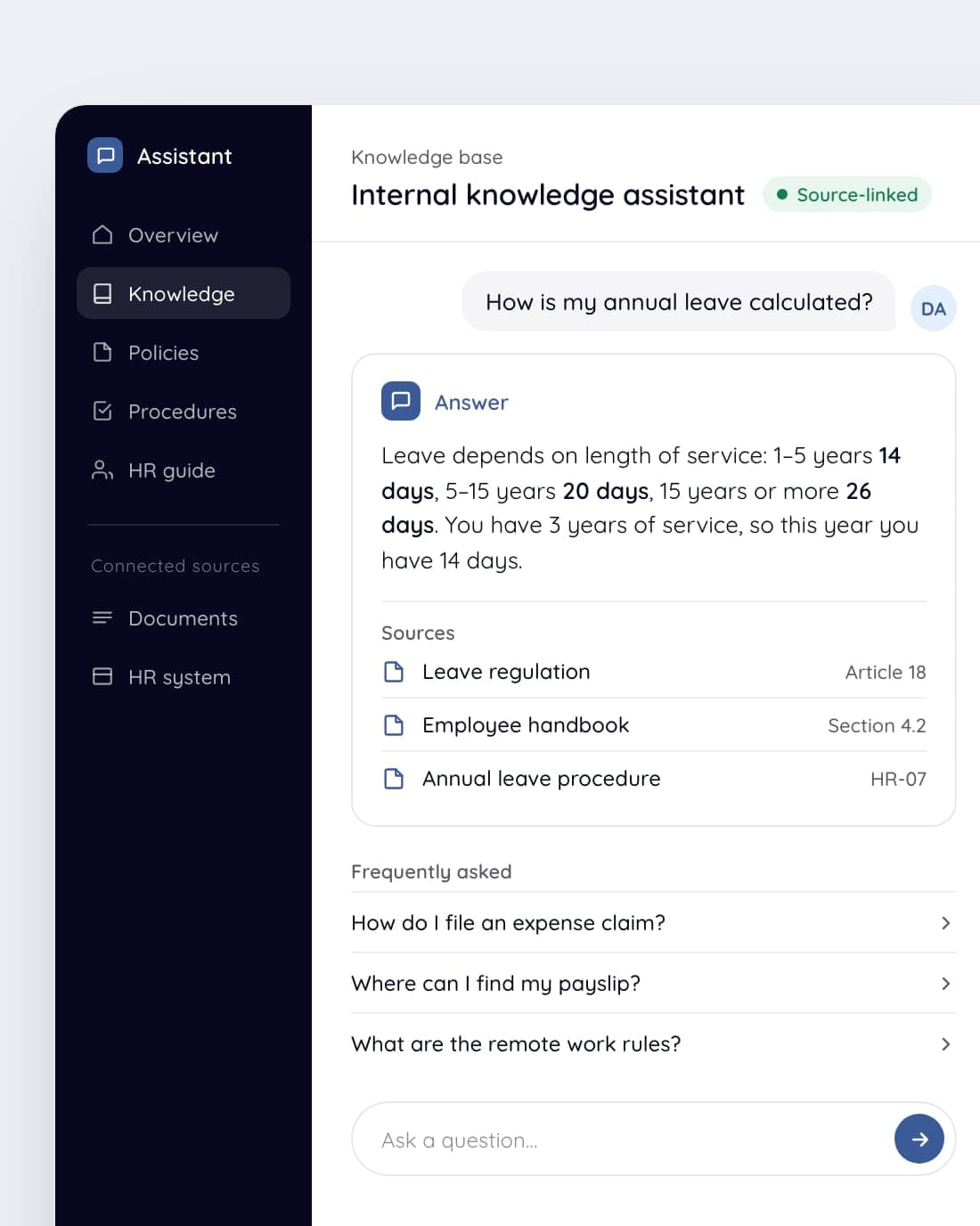
- Internal knowledge base: An agent working over contracts, policies and SOPs answers staff questions with sources.
- Supply chain and stock: Demand forecasts determine when to order and from which supplier.
- Business logic: The agent is trained on the company’s own rules, workflows and terminology.
- Taking action: The agent sends emails, updates databases and creates reports.
Customer Support Assistants
Most of a support queue is the same questions and order-status lookups. The assistant answers from company documents and checks the order system for status; complaints and exceptions go to a specialist.
- Slack
- CRM
- API
View detailsHide details
- Document-grounded answers: The assistant answers from company documents and shows its source.
- Order status: It connects to the order system and tells the customer where their order is.
- Hand-off to specialists: Complaints and exceptions go to the right specialist, with priority, under defined rules.
- Living knowledge base: New answers given by specialists are added to the knowledge base.
The BBCo difference
A system your team can put to use.
During the pilot, we review time savings, accuracy and exceptions together. Suitable processes are handed over with documentation, access rules and team training.
Why BBCo
Working rules alongside implementation.
Department-specific agents: connected to your data, trained on your rules, measured in hours when the work is done.
Data boundaries are agreed upfront.
Data flows, provider terms and access permissions are reviewed before implementation to select suitable infrastructure.
Not a generic chatbot: an agent that runs on your rules.
The department’s workflow, approval chain and jargon are the build’s input; the agent is trained for your process, not a generic one.
We talk in before/after hours, not guesses.
Handed-off work is measured in weekly hours per process; the gain shows in the report and on your own dashboard.
Problem → solution
The six complaints we hear most, and our answer to each.
Open a row to see our approach and the parts of the solution we set up.
Data entry, email follow-up and lead qualification are handed to the agent; the salesperson only approves. The CRM stays current and nobody fills in forms.
- Incoming request read, CRM record created
- Lead scored and queued
- Follow-up drafted, sent on approval
Process
How we work.
We review the process first, then start with a focused pilot. Scope and data readiness determine the schedule.
Discovery
ReviewWe speak with teams, review processes and data sources, and identify suitable work for a pilot.
StartPilotDeliverable
Opportunity map
Pilot
BuildWe build a small pilot and measure accuracy, time and the need for human review.
PilotReviewDeliverable
Tested workflow
Rollout
TrainingWhat works rolls out; policy is written, internal owners are trained, ownership is handed over.
ReviewHandoverDeliverable
Usage guide and team traininghandover done
Who it fits
Who we can help.
If one of these sounds like you, let’s define the scope together in a first call.
Get a proposal- Companies that want AI but don’t know where to start
- Leaders who bought tool licences nobody uses
- Growing companies slowed down by repetitive operations
FAQs
Frequently asked questions
If your question isn’t answered here, write to us through the form at the end of the page and our team will get back to you.
Ask your questionServices
Our other services
 AI StudioAI imagery, video, voiceover and variation at scale.
 Web & AppCorporate sites, Shopify, landing pages and mobile apps.
 GEO-SEO-AEOTechnical SEO, content architecture and generative-engine visibility.
 Digital MarketingPerformance ads, creative testing and measurement.
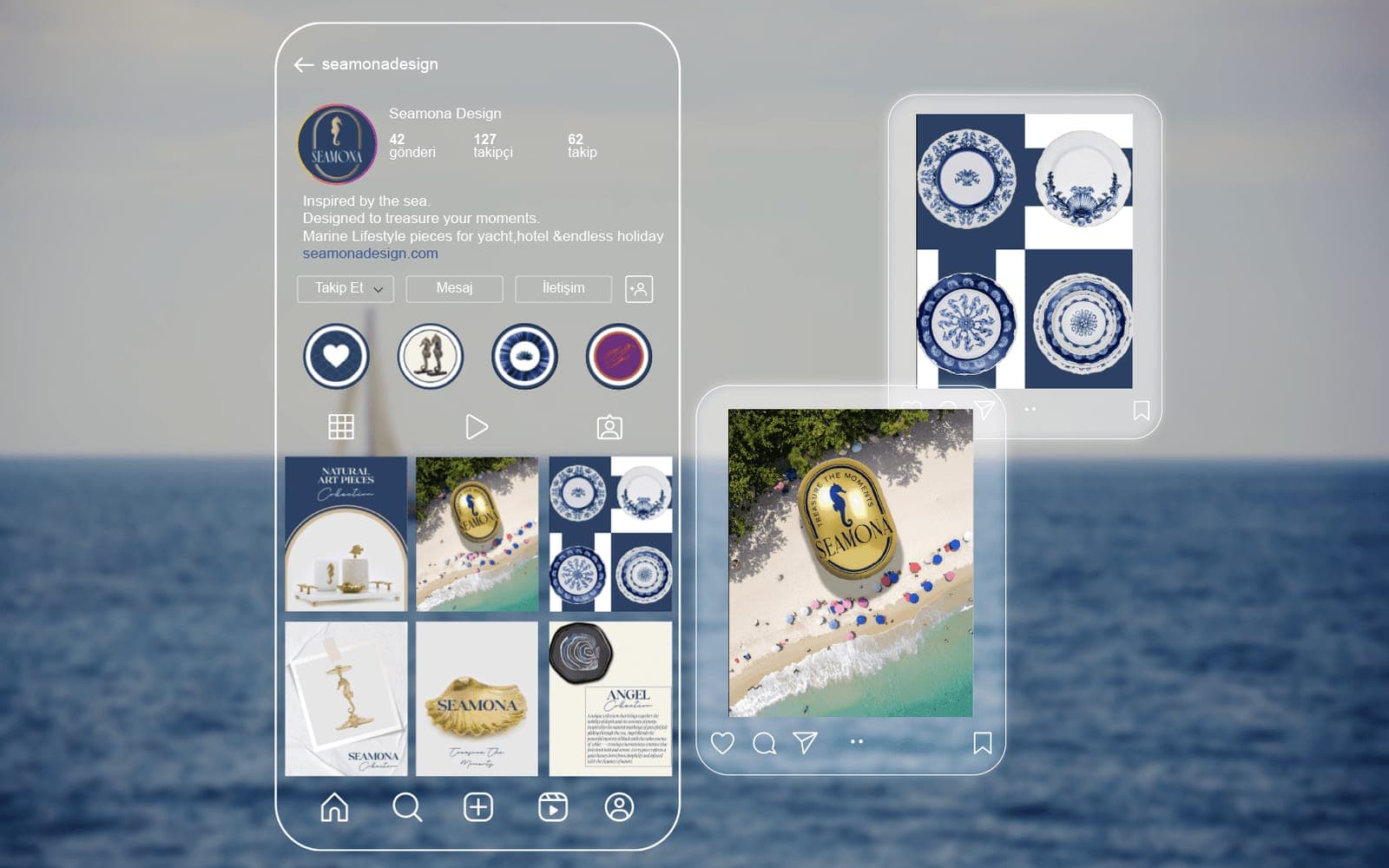 Social Media ManagementContent calendar, production, community and influencers.
 Marketplace ManagementListing, marketplace ads, pricing and stock management.
 E-ExportTarget country, market research, warehouse setup, and marketplace and ad management.
AI transformation
What takes up your team’s time?
Tell us what you need in a few sentences. Our team will get in touch.